Women's History Month: What to Read
If there's one thing I leaned from Women, Race, & Class, it's that I have a lot to learn in regard to Black women and our history on American soil - specifically, post slavery. Since January I've been reading literature that tells the stories we have not heard, from the women who must be remembered.
Don't feel pressure to read every single book on this list, but, please consider reading at least one:
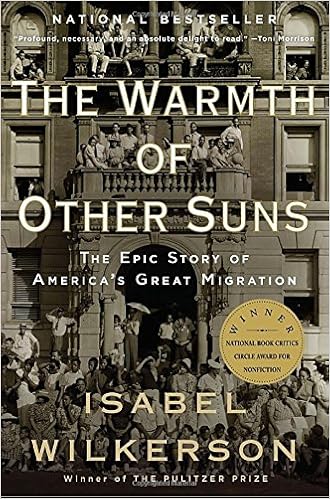
The Warmth of Other Suns by Isabel Wilkerson
This nonfiction tells the stories of three Black Americans and their families, who had to flee the south to escape wrongful imprisonment, lynching, and other barbaric cruelty that was common practice in the post Reconstruction era south. Using candid interviews, extensive research, and poignant stories of people who did and did not survive the Great Migration, Wilkerson details the journey of three Black Americans: George Swanson Starling, Robert Joseph Pershing Foster, and Ida Mae Brandon Gladney. Ida Mae, a migrant who fled Mississippi in the 1930's with her two children and husband for Chicago, would outlive Jim Crow and later vote for fellow Chicagoan and then-Senator Barack Obama. Pulitzer prize winning The Warmth of Other Suns educates you without feeling like you're in class, and explains in plain terms not only why it is important to pay homage to the Black and Brown Americans who fled the south, but what those brave Americans went through to stay alive.
Buy From Mahogany Books
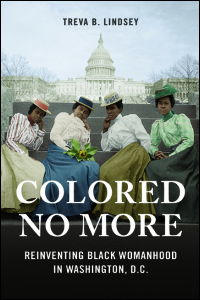
Colored No More: Reinventing Black Womanhood in Washington D.C. by Treva B. Lindsey
Colored No More gives a great introduction into the New Negro era that took place at the turn of the Twentieth Century, specifically, the role that Black women played. This historical treasure addresses topics such as respectability politics, sexuality, and the business of our hair (and, it was indeed a business). Many historic figures that often go overlooked are talked about in Colored No More. Some standouts are tennis star, lesbian, and first dean of women's studies, Lucy Diggs Slowe, scholar and activist, Mary Church Terrell, and activist and business woman, Nannie Hellen Burroughs. These successful Black women, and many more, excelled in their activism, education, business ventures, and art. Their success took place during a time when Blacks found oppression at every turn. The fact that these women broke barriers and paved a way for ambitious Black women who followed (myself included) is worthy of a book. The fact that their names are foreign to the average American is shameful.
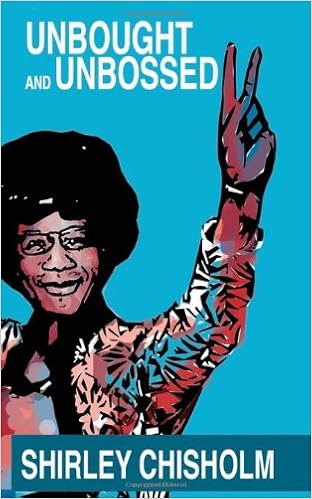
Unbought and Unbossed by Shirley Chisholm
Her name is one that is usually said in passing. Usually as a reminder to women who use the words 'Hillary' and 'first' in the same sentence that, this has been done before.
Brooklyn born in 1924 to West Indian parents, Shirley Chisholm climbed her way up to the top of the political ladder without selling dreams, mincing words, or the free promotion of social media. In her own words, Chisholm describes her experience growing up in New York City and pursuing a career in politics, despite the intersections that her gender and race presented.
While many people know Shirley Chisholm as simply the first Black woman elected to congress, most forget to question how she got their. Unbought and Unbossed is a testimony for immigration, a blueprint for any woman who entertains the idea of running for office, and a reminder to Black women that, as Shirley said, "If they don't give you a seat to the table, bring a folding chair."
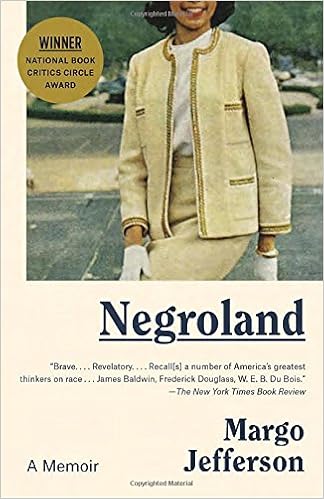
Negroland: A Memoir by Margo Jefferson
Negroland is a rich tale of Black opulence, oppression, elitism, and finding acceptance for one's Black skin during a time where acceptance is limited to a sign hanging over a bathroom telling one they could or could not enter.
Jefferson, born in 1947 to a physician for a father and a socialite for a mother, uses her childhood, which took place in Chicago, to explain the unique lifestyle for Black Americans who were well-off enough to afford housing outside the ghetto, but never too well-off to be denied privileges others had right to.
Addressing sensitive topics such as colorism and sexism, Negroland does an outstanding job of painting a portrait of life for Black Americans who had "more options" during the civil rights era.
Buy From Mahogany Books!
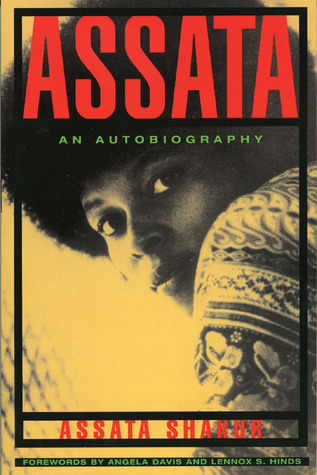
Assata: An Autobiography by Assata Shakur
America wants the world to believe that Assata Shakur is a cold blooded killer. She is not.
Growing up under the white gaze of 1950's racially-charged America, Assata Shakur was firm in her resistance of the American government which wanted her to believe she was bad, simply for being Black and demanding equality.
From the beginning pages, her experience with police is one that is filled with lies, brutality, assault, and humiliation, not unlike the tales of others who are victim to the system. Assata's life on American soil was cut short after being wrongfully accused of the murder of a New Jersey state trooper, in incident in which Assata herself had been shot. After four years of imprisonment, Assata escaped from prison, assisted by the Black Liberation Army, living for a fugitive for several years, before resurfacing in Cuba, where she would be granted political asylum.
Assata is filled with facts, poetry, and a true American story about the lengths that one Black woman had to go to gain her freedom.
Buy From Mahogany Books!
Please contribute here if you appreciated these recommendations

Comments
Post a Comment